- Coolant
- 85 °C
- Boost
- 1.42 bar
- Fuel
- 74.9 L/h
GlassBridge Propulsion Intelligence
Your yacht already knows what is happening.
GlassBridge understands what it means.
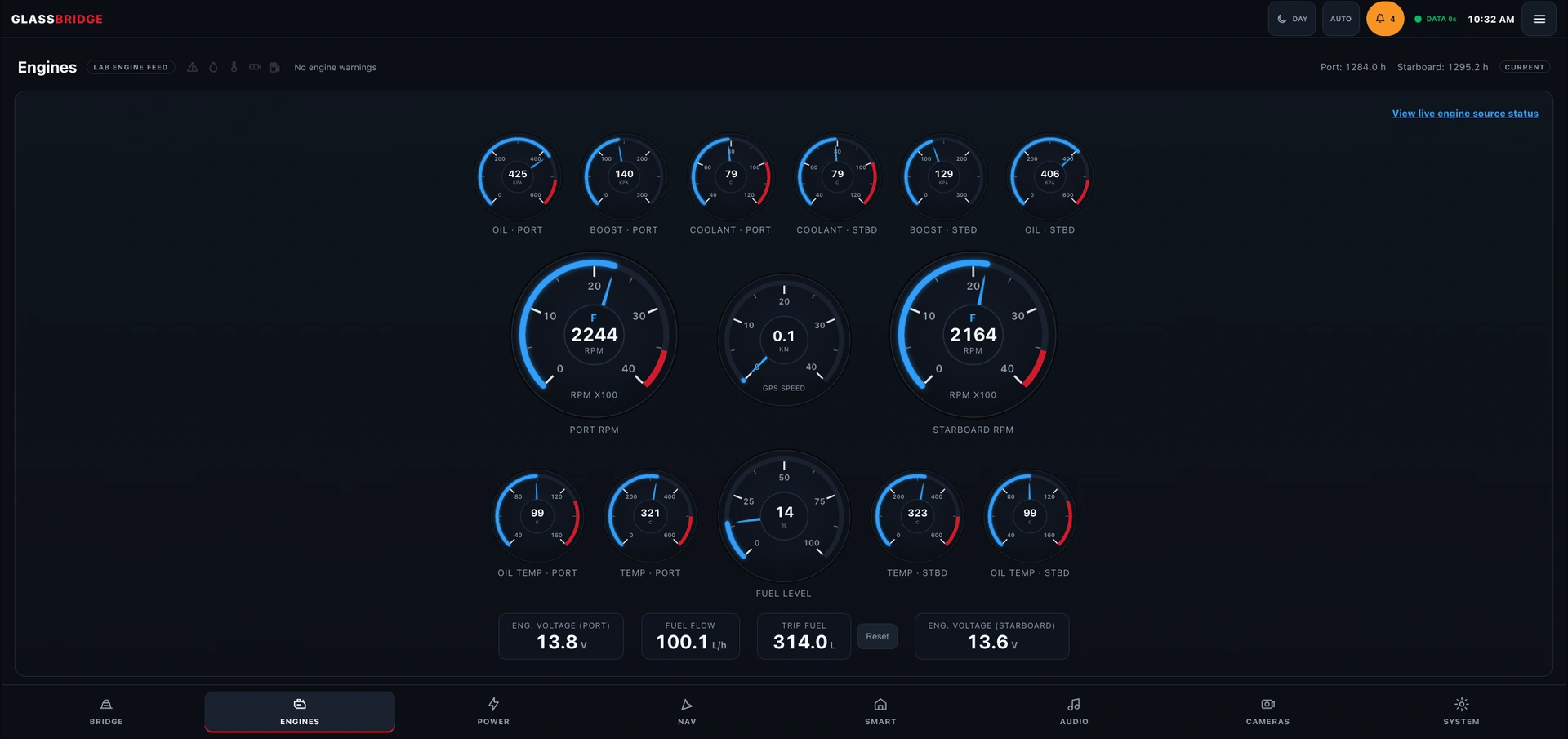
GlassBridge is designed to turn live propulsion and vessel telemetry into real-world engine health, fuel efficiency, range, trip intelligence and early warning — without taking control away from the systems designed to run your yacht.
Compatible with supported NMEA 2000 propulsion installations.
From telemetry to intelligence
More than engine data.
Modern propulsion systems already monitor hundreds of operating conditions.
GlassBridge brings supported observations together with speed, position, fuel, electrical and historical vessel data to answer the questions that matter.
Twin-engine intelligence
Two engines.
One powerful diagnostic advantage.
On a twin-engine yacht, port and starboard propulsion systems operate under almost identical conditions. GlassBridge is being designed to compare them continuously.
A difference in boost, fuel consumption, temperature, pressure or gearbox behaviour can become meaningful before it becomes obvious from a traditional gauge.
- Coolant
- 86 °C
- Boost
- 1.40 bar
- Fuel
- 74.6 L/h
GlassBridge Insight
Comparable behaviour has changed.
Starboard boost has remained below the comparable port-engine baseline while fuel consumption is elevated.
Suggested inspection if the trend persists.Design demonstration. GlassBridge insights support, but do not replace, OEM diagnostics and qualified marine service.
Explainable health
Engine health you can understand.
GlassBridge will not hide health behind a single unexplained score.
Every insight is intended to show the supporting telemetry, historical comparison and reason behind it.
- Current starboard coolant
- 89.8 °C
- Historical comparable range
- 84.1–87.0 °C
- Trend
- +3.4 °C over 41 operating hours
Illustrative reasoning path. No commissioned yacht engine feed supports these values.
Learned performance
Not brochure range.
Your range.
Sea state, load, bottom condition, fuel, weather and cruising style all affect a yacht's real performance.
Propulsion Intelligence is being designed to build a comparable performance history from the yacht itself.
Based on 28.4 hours of comparable cruising data
| RPM | Speed | Fuel | Efficiency |
|---|---|---|---|
| 1,200 | 9.1 kn | 42 L/h | 4.62 L/nm |
| 1,600 | 14.5 kn | 103 L/h | 7.10 L/nm |
| 1,800 | 20.8 kn | 142 L/h | 6.83 L/nm |
| 1,890 | 23.2 kn | 146 L/h | 6.31 L/nm |
| 2,000 | 25.1 kn | 171 L/h | 6.81 L/nm |
GlassBridge is being designed to learn how this yacht performs — not how a generic yacht is expected to perform.
Estimated range
Know what the fuel gauge cannot tell you.
Fuel remaining is only part of the answer. GlassBridge is being designed to combine fuel aboard, reserve policy, current consumption and comparable vessel performance into a practical estimated range.
Design demonstration only. This is not route planning or safe-navigation guidance.
Trip intelligence
Every trip tells a story.
Owners see what the yacht used. Captains understand how the yacht performed.
Fleet and charter operators will be able to review permitted usage without digging through disconnected systems.
Design demonstration · illustrative values
Access and location visibility are always controlled by vessel permissions and roles.
Early warning
An alarm tells you something is wrong.
GlassBridge can help you see what is changing.
Traditional alarms are essential. Propulsion Intelligence adds another layer by comparing port with starboard, today with historical operation, temperature with comparable load, fuel burn with speed, boost with RPM, and gearbox behaviour over time.
Starboard coolant temperature has increased approximately 4.6 °C at comparable RPM and seawater conditions over the last 73 operating hours.
Suggested: Inspect the cooling system at the next suitable service opportunity if the trend persists.
Illustrative insight. GlassBridge does not diagnose a failure unless the underlying OEM system supplies that fault explicitly.Departure readiness
One answer before you leave.
GlassBridge combines propulsion with the rest of the yacht.
One view. One status. One platform.
- Port engine online
- Starboard engine online
- No active engine alarms
- Transmission data normal
- 84% reported
- Estimated safe range 192 nm
- House bank available
- Generator available
- Shore disconnected
- Position available
- Heading available
- AIS available
- Door state reviewed
- Camera sources available
- Anchor state reviewed
Readiness remains advisory and installation-specific. Certified systems, watchkeeping and physical departure checks remain authoritative.
- Engines started
- 09:07
- Vessel departed
- 09:14
- Propulsion
- Normal
- Fuel
- 81%
No active propulsion alerts
Design demonstrationConnect
The yacht doesn't stop existing when you step ashore.
Through the separately authenticated GlassBridge Cloud, authorized owners and crew can keep read-only visibility over approved vessel status from anywhere the yacht has connectivity.
The propulsion notification view shown here is a design demonstration. It does not provide remote engine start or stop.
Review GlassBridge CloudVolvo Penta / NMEA 2000
Built on marine standards.
Designed above them.
GlassBridge can consume supported engine and vessel telemetry through NMEA 2000 and the yacht's existing marine network architecture.
On compatible Volvo Penta installations, available values depend on the propulsion system, EVC generation, vessel configuration and installed interfaces.
Supported operating information can include
- RPM
- Engine hours
- Fuel rate
- Temperatures
- Pressures
- Voltage
- Transmission state
- Tank information
- Engine status
Exact values depend on the commissioned source path. Missing or uncommissioned data is never silently presented as vessel truth.
GlassBridge does not need to take control of propulsion to make its data more useful.
Volvo Penta is referenced only for factual interoperability. GlassBridge does not claim Volvo Penta certification, approval or official partner status.
For yacht builders
A smarter yacht without redesigning the yacht.
Modern boats already contain sophisticated propulsion, navigation, electrical and control networks.
GlassBridge is designed to sit above those systems — normalizing approved data into one intelligent yacht experience while preserving original controls.
No builder or manufacturer partnership is implied. Integration scope follows the vessel, selected equipment and written project definition.
Talk to GlassBridge About OEM IntegrationArchitecture
One yacht.
One intelligence layer.
GlassBridge Propulsion Intelligence
The connected yacht was only the beginning.
GlassBridge makes it understandable.